




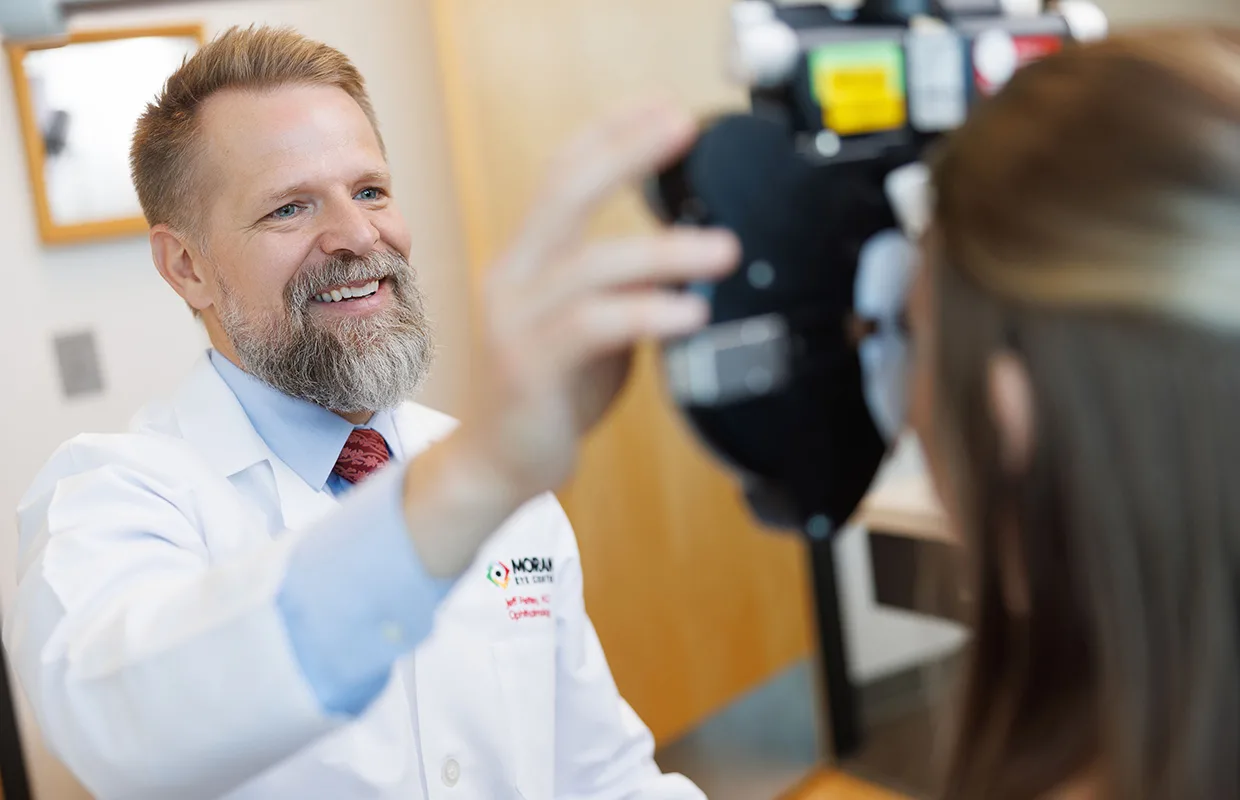
The John A. Moran Eye Center at the University of Utah is recognized for delivering compassionate, comprehensive, and high-quality care. Jeff Pettey, MD, MBA, CEO and Chair of the Department of Ophthalmology and Visual Sciences at the University of Utah, reflects on his path to medicine and shares how the center is shaping the future of eye care.
COMMITTED TO HOPE, UNDERSTANDING, AND TREATMENT
Jeff Pettey, MD, MBA says his path to a career in medicine started with an unexpected discovery.
“At the age of 19, I was living in Southern Russia, a place I’d only heard about through the lens of Cold War narratives,” he says.
“What I discovered was the people I’d been taught to see as different from me weren’t different at all. They had the same hopes, insecurities, and capacity for joy and love that I experienced in my own life.”
The experience of shared humanity proved formative for Pettey, now CEO of the John A. Moran Eye Center (Moran Eye Center) and Chair of the Department of Ophthalmology and Visual Sciences at the University of Utah. While studying Russian literature, he found himself increasingly drawn to medicine. The field combined two things inspiring him: scientific discovery and people.
In medicine, Pettey gained an opportunity to care for his patients and empower others in the field through teaching and mentoring. Throughout his career, he has recognized opportunities to make a difference and stepped through doors to see where they lead.
“Medicine is the perfect synthesis – a way to understand how the world works at a biological level while remaining deeply connected to the human experience,” he says.
This ethos is crucial as healthcare is at a pivotal moment. With unprecedented advances in technology, data, and connectivity, the potential exists to deliver high-quality care more broadly than ever before.
However, significant challenges remain as systems haven’t kept pace. The US, specifically, still faces fragmented access, complex insurance systems, and a heavy administrative burden for physicians.
“If we don’t tackle these structural issues, disparities in health outcomes will only increase, but what gives me hope is that we know the problems and can redesign the system to be better for both patients and caregivers,” details Pettey.
One of the biggest opportunities he sees is removing non-care-related burdens from physicians’ daily work. When doctors can focus on what they were trained to do, they become more engaged, fulfilled, and effective.
“Thoughtful leadership that emphasizes purpose, trust, and empowerment instead of pressure or financial incentives can fundamentally change how care is delivered. We have the chance to build something better, and that’s what drives me every day,” he says.
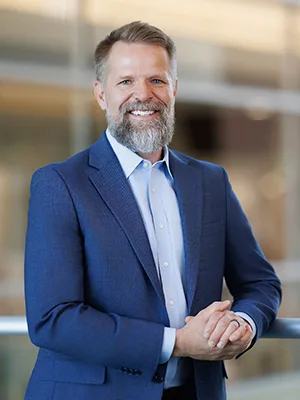
“Medicine is the perfect synthesis – a way to understand how the world works at a biological level while remaining deeply connected to the human experience”
Jeff Pettey, MD, MBA, CEO, John A. Moran Eye Center and Chair, Department of Ophthalmology and Visual Sciences, University of UTAH
SIGHT-SAVING SERVICES
The Moran Eye Center is a premier US academic vision center and the largest ophthalmology clinical care, education, and research facility in the Mountain West.
It is guided by a clear goal: that no person with a blinding condition, eye disease, or visual impairment should be without hope, understanding, or treatment. Its work falls into four pillars, namely clinical care, research, education, and outreach.
“Our vision statement guides everything we do, including how we care for our patients, design research programs, train future ophthalmologists, and extend sight-saving services to communities in need,” says Pettey.
Specifically, the center operates 11 satellite locations, employs more than 500 faculty and staff, and in the last fiscal year provided 188,582 patient visits and performed 10,786 surgeries. Additionally, it supports 20 research laboratories and centers, with its robust research enterprises boasting $9.8 million in research grants, 90 clinical trials, and over 175 scientific publications in 2025.
What distinguishes the Moran Eye Center is the integration of clinical care excellence and research, supported by internationally recognized physicians and a unique research infrastructure that enables innovation on a rare scale.
These unique resources include its four key centers driving discoveries – the Sharon Eccles Steele Center for Translational Medicine (SCTM), Intermountain Ocular Research Center (IORC), Utah Retinal Reading Center (UREAD), and Alan S. Crandall Center for Glaucoma Innovation (CCGI).
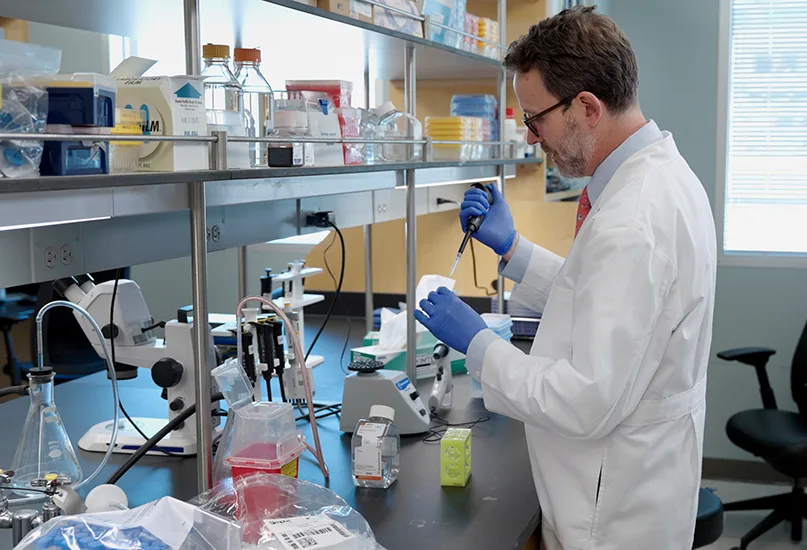
“Beyond these four centers, the Moran Eye Center itself is an ideal environment for discovery: two towers connected by bridges house both clinical care and research labs in one building,” explains Pettey.
INNOVATION AT SCALE
Three initiatives exemplify the Moran Eye Center’s commitment to translating innovation into meaningful improvements in patients’ lives.
The first such effort is underway at the SCTM, which has developed a gene therapy for the most prevalent form of age-related macular degeneration (AMD). The disease is a leading cause of blindness for adults 60 and over worldwide.
The therapy is now in clinical trials. If successful, it stands to change the treatment landscape for millions of people worldwide at risk of blindness from AMD.
A second initiative to change how another major blinding disease is diagnosed, monitored, and treated is underway at the CCGI, led by Iqbal Ike K. Ahmed, MD, FRCSC.
“This work is critically important since people often permanently lose vision to glaucoma before it is even diagnosed,” says Pettey.
The third effort is what Pettey calls the Polaris project, or the center’s commitment to ensuring everyone, regardless of where they live or their ability to pay, can experience life at its fullest through the highest possible level of eye health.
The initiative was inspired by the work of Moran Eye Center outreach teams conducting pediatric vision screenings for students in schools on the Navajo Nation. During the screenings, teams discovered children had high rates of vision issues but no access to eyeglasses. This had impacted crucial years for childhood learning and development.
“Polaris aims to change that by making a shift from existing care models into a population-based approach focusing on quality, value, and access,” says Pettey.
The center is deploying pediatric vision screening devices throughout Utah, alongside building a tele-ophthalmology network. It is also integrating artificial intelligence (AI)-assisted diagnosis and risk stratification to identify who needs care and provide it faster.
“The only way to meaningfully improve eye health at scale is through integrated public health networks supported by new technologies. Polaris enables us to extend our clinical excellence beyond our clinics while upholding the highest standards of care,” says Pettey.
This reflects the Moran Eye Center’s broader responsibility not just to treat disease when people make it to their door, but to systematically improve eye health outcomes for entire populations.
“We are in a period of extraordinary change for eye care, and the Moran Eye Center is uniquely positioned to shape the future of vision research and care”
Jeff Pettey, MD, MBA, CEO, John A. Moran Eye Center and Chair, Department of Ophthalmology and Visual Sciences, University of UTAH
SHAPING THE FUTURE OF VISION AND CARE
The Moran Eye Center has long been committed to helping underserved communities and extending access to high-quality eye care.
In 2012, Pettey co-founded the Operation Sight program, which provides free, sight-restoring cataract surgery to uninsured and underinsured Utahns. Today, the Moran Eye Center’s Global Outreach Division serves underserved patients in Utah and works to teach and train new physicians to expand access to care in more than 20 low-resource countries.
In Utah, Moran Eye Center volunteer physicians and medical personnel make regular visits to provide care on the Navajo Nation. At community clinics in Salt Lake City and Park City, they provide care and charitable, no-cost surgeries for the unhoused and new Americans through Project Homeless Connect and the Hope in Sight Clinic.
In low-resource countries, volunteers conduct eye care missions in places such as Tanzania to train ophthalmologists and nurses. At the Moran Eye Center, international observers can spend six months training. The center also provides a free, online ophthalmology education resource (morancore.utah.edu).
As the center looks ahead to a continued future of research excellence, world-class care, and community service, the stakes have never been higher.
“We are in a period of extraordinary change for eye care, and the Moran Eye Center is uniquely positioned to shape the future of vision research and care,” says Pettey.
With global visual impairments projected to reach 1.8 billion by 2050, researchers need to develop new ways to fight increasing rates of sight loss, and the Moran Eye Center is rising to this international challenge.
The center is expanding access to care, accelerating research that changes the course of eye diseases, and reimagining what it means to deliver hope and healing on a global scale. Specifically, it is working to enhance early disease detection and diagnosis; personalized treatment plans; remote screening and teleophthalmology; continuous monitoring and home-based care; drug development and clinical trials; accessibility and affordability; and education and training.
Pettey is confident he has the right team for the job.
“Our greatest strength is our people – faculty, staff, trainees, donors, and partners. Together, we are shaping a better future with hope, understanding, and treatment for all,” he concludes.