



In healthcare, every second matters. Steven Try, Channel Manager UK & Ireland for Snom Technology, highlights why effective and reliable communication technologies are essential to evolving healthcare environments.
AT THE HEART OF HIGH-QUALITY CARE
Whether locating an on-call doctor, coordinating a patient transfer, or responding to an emergency alarm, the ability of staff to communicate quickly and reliably directly impacts patient safety.
Within a system as large as the UK’s healthcare sector, this is a considerable challenge. The NHS alone employs more than 1.3 million people in England, whilst the wider health and social care ecosystem supports several million roles across the country.
Healthcare providers such as hospitals, clinics, and nursing homes are focused on delivering high-quality patient care, and digital tools are becoming an essential part of making that possible. Technology is helping to streamline workflows, improve coordination between teams, and ensure staff can access information quickly.
Effective communication systems are central to this, helping staff work together more efficiently and respond more rapidly in emergencies. Any communication solution must be able to meet multiple requirements, however. With healthcare often being a busy and high-pressure environment, devices need to work reliably and comply with strict safety and hygiene standards.
TECHNOLOGY DESIGNED FOR IMMEDIACY
One of the biggest challenges for healthcare IT teams in hospitals is that communication needs vary. What works in one building, floor, or unit may not work in another. Mobility will always remain essential, though, as individuals are frequently on the move between wards, patient rooms, and departments during their shifts.
The use of Digital Enhanced Cordless Telecommunications (DECT) over IP technology is proving to be an effective solution. By combining the reliability of DECT – which operates on a dedicated frequency band separate from Wi-Fi and Bluetooth – with an IP-based system, healthcare providers can deploy secure wireless communications whilst maintaining stable voice connectivity across large buildings.
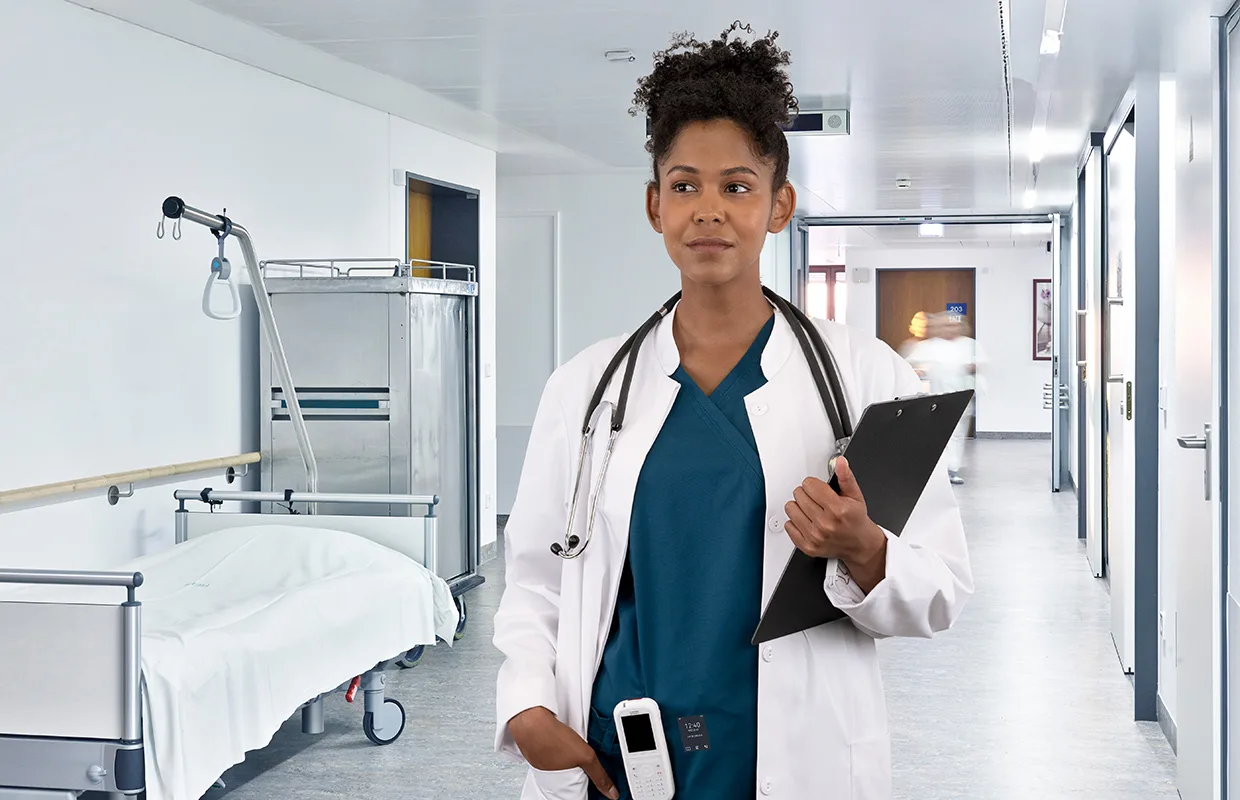
For healthcare professionals, a DECT IP cordless handset does far more than make calls. For example, if a patient’s condition suddenly deteriorates, staff can instantly alert colleagues with the press of a dedicated alarm button.
Additionally, rolling out a beacon solution and placing tags on other handsets means staff can locate other team members within seconds. When these tags are placed on medical equipment, this can also speed up the time to locate the nearest ultrasound scanner or blood pressure monitor.
These wireless handsets are also very useful for everyday care management. Function keys on handsets can be configured to trigger specific actions, such as activating alarms or updating digital records via the IT system. When one of these keys is pressed, a signal is sent over the provider’s wireless network back to the central server that manages patient records. A member of staff might press a ‘medication given’ key to immediately log when medication has been administered.
RESPECTING HOSPITAL HYGIENE STANDARDS
Whilst reliability and mobility are essential, hygiene is another critical consideration.
Infection control and prevention don’t just apply to operating theatres or surfaces, but also to devices that are handled by several members of staff. These shared communication tools can contribute to the spread of bacteria and viruses if they are not designed with suitable materials.
To address this, manufacturers such as Snom Technology have created devices equipped with special protective covers certified according to the industrial standard JIS Z 2801, which can withstand frequent cleaning with ethanol-based disinfectants.
This special casing ensures the phones don’t become a breeding ground for bacteria and remain compliant with the strictest health protocols. These design considerations are especially important in intensive care units, neonatal units, or operating theatres, where even a minor lapse in infection control can have serious consequences.
In addition, DECT IP phones offer specific features to support cleaning in patient rooms and operating theatres. For example, nurses can send a notification when a room is ready for cleaning with a single button push. This alert is immediately sent to the cleaning team, who in turn can update the status of the room after completing their work – ensuring a quick turnaround and improving coordination between different departments.
ADAPTING TO COMPLEX HEALTHCARE ENVIRONMENTS
Another persistent challenge when setting up communication systems is the physical complexity of buildings. Many hospitals operate from ageing buildings, with thick walls and multiple floors that complicate wireless coverage.
Devices that rely on Wi-Fi networks may struggle with dead zones or signal congestion. But DECT multi-cell solutions are designed to provide consistent coverage – no matter how large or architecturally complicated the building.
Multiple base stations can be deployed across a single building to ensure coverage is maintained across different wards and departments – and staff remain connected wherever they are.
Automatic provisioning and centralised management also help reduce the burden on IT teams by simplifying deployment and maintenance of these devices.
IMPROVING EFFICIENCY AND PATIENT EXPERIENCE
In an environment where speed is so often of the essence, seamless communication can impact both operational efficiency and the quality of patient care.
Optimising processes such as locating staff, managing emergency situations, and finding free bed space has a direct influence on staff and patient experience, as well as the sustainability of the healthcare system.
DECT IP technology represents an intelligent, scalable solution that is aligned with the current challenges facing healthcare providers.
Its ability to integrate into critical environments, guarantee hygiene, facilitate mobility, and improve internal communication makes it a key support for hospitals and social healthcare centres that are undergoing digital transformation.