




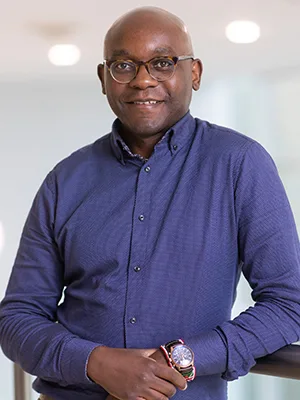
The healthcare industry is at a pivotal point, with the need to merge innovative technology and a patient-first approach at the forefront. Dr Serufusa Sekidde, Chief of Staff to the CEO at Viiv Healthcare, speaks to the growing importance of artificial intelligence in healthcare, especially its role in the future of the industry in Africa.
HOW AI CAN TRANSFORM AFRICAN HEALTHCARE
When I was a medical student in China, my mother died from tuberculosis (TB) in Uganda. What hurt the most was that I knew that the disease was not invincible. Unfortunately, there was a perfect storm of her chest X-ray sitting waiting for weeks to be read, then her treatment being delayed, and then no one to connect the dots for her when her treatment went awry and damaged her liver.
For millions across Uganda, Kenya, and South Sudan – the African countries where I’ve worked as a doctor – their reality is shaped by the same delays my mother faced: in seeking care, diagnosis, and in treatment. We can change the trajectory of healthcare in Africa and save people like my mother by leveraging artificial intelligence (AI).
There are three ways to do this, namely making sure the source of healthcare data is robust, leveraging AI at scale across this data as a tool of empowerment, and lastly, humanising AI by centring it around patients and caregiver experience.
First, Africa’s healthcare data needs to be reasonably clean, complete, and compatible across healthcare centres, as a solid foundation for AI to work its magic. In my secondary school in Kenya, I remember using the Microsoft Disk Operating System (MS DOS) on a cranky desktop with a floppy disc and learning about ‘garbage in, garbage out. This is the concept that poor quality information or input produces a result or output of similar quality.
With faulty source data, AI is moot. As a consultant for the World Health Organisation (WHO) in the Middle East and Africa in 2014 and 2015, I saw first-hand how African healthcare systems are hampered by data that is not only poor quality but also neither connected nor transferable from one facility to another.
Even worse, the responsibility is left to the patients to move with their records – often incomplete – across their healthcare providers. For AI to stand a chance in African healthcare, we need good-quality healthcare data that is coordinated and connected across all hospitals and community centres.
Secondly, once we are reasonably comfortable with the source data and its governance, we need to leverage AI at scale as a tool of empowerment, rather than just automation. I’m an AI dreamer, and I can imagine a future where a digital agent in a rural South Sudan clinic – like the one I ran prior to the country gaining independence – supports nurses with reminders, tracks patient follow-ups, and escalates emergencies before they become tragedies.
I know that the quality of care by my incredibly talented African medical colleagues is top-notch, but it is the follow-up and surrounding care where we still have huge gaps in Africa. We need AI to amplify our skills, compassion, and post-hospital support.
TRANSFORMING HEALTH-SEEKING BEHAVIOURS
Whilst we welcome the AI giants of the world to partner on Africa’s journey, I’m even more excited that we have our own solutions!
The continent’s AI sector is valued at USD$4.5 billion in 2025 and is rising rapidly. It is not a footnote in the global narrative. African start-ups like Kito Health – where my partner is co-Chief Medical Officer – are building digital platforms to democratise and transform health-seeking behaviour for caregivers of children.
Kenya’s Qhala, founded by Aspen New Voices Senior Fellow, Dr Shikoh Gitau, is redefining healthcare innovation through the deployment of AI to address systemic challenges such as workforce shortages, disease surveillance, and access to care.
The Africa Centre for Applied Digital Health, started by my colleague Dr John Mark Bwanika, is a Kampala-based non-profit transforming Africa’s healthcare landscape through AI and data science. All this heralds the emergence of solutions built for us, by us.
Lastly, we must centre AI-based healthcare solutions around the patient and caregiver experience. For years, we in the African diaspora have played doctor-on-the-phone like I did with my mother when she had TB and my dad when he had a stroke, deciphering symptoms, reading emails at midnight from relatives, and navigating care from afar. It’s exhausting and unsustainable, but borne out of necessity.
Let’s leverage this experience of being caregivers to develop fit-for-purpose AI solutions. Agentic AI stands to transform this diaspora lifeline into something systematic and scalable, potentially equipping our healthcare data and memories with much-needed continuity.
For a mother managing her child’s asthma in Ouagadougou or a young man living with HIV in Lagos, these bots could remember, remind, and ensure that no crucial detail is left behind.
BUILDING A ROBUST HEALTHCARE INFRASTRUCTURE
To be sure, Africa’s healthcare landscape is challenging. Human resources are stretched, infrastructure is crumbling, and public sector funding is insufficient, but Africa is also a continent of possibility, and AI can help us unlock doors we dared only knock on before.
As a 2025 Black British Business Awards 2025 Winner (Senior Leader – STEM category), I urge my fellow business leaders both in Africa and in the diaspora to invest in Africa’s AI-powered healthcare, not for charity, but for sustainable growth and impact.
African policymakers should invest in robust healthcare digital infrastructure and put data protection at the heart of national policy. All of us in the diaspora should embrace the lessons from our informal caregiving and help AI turn it into scalable, sustainable, and transformative digital action.
My mother’s story is, unfortunately, still not unique. The time for change, turbocharged by AI, is now.